

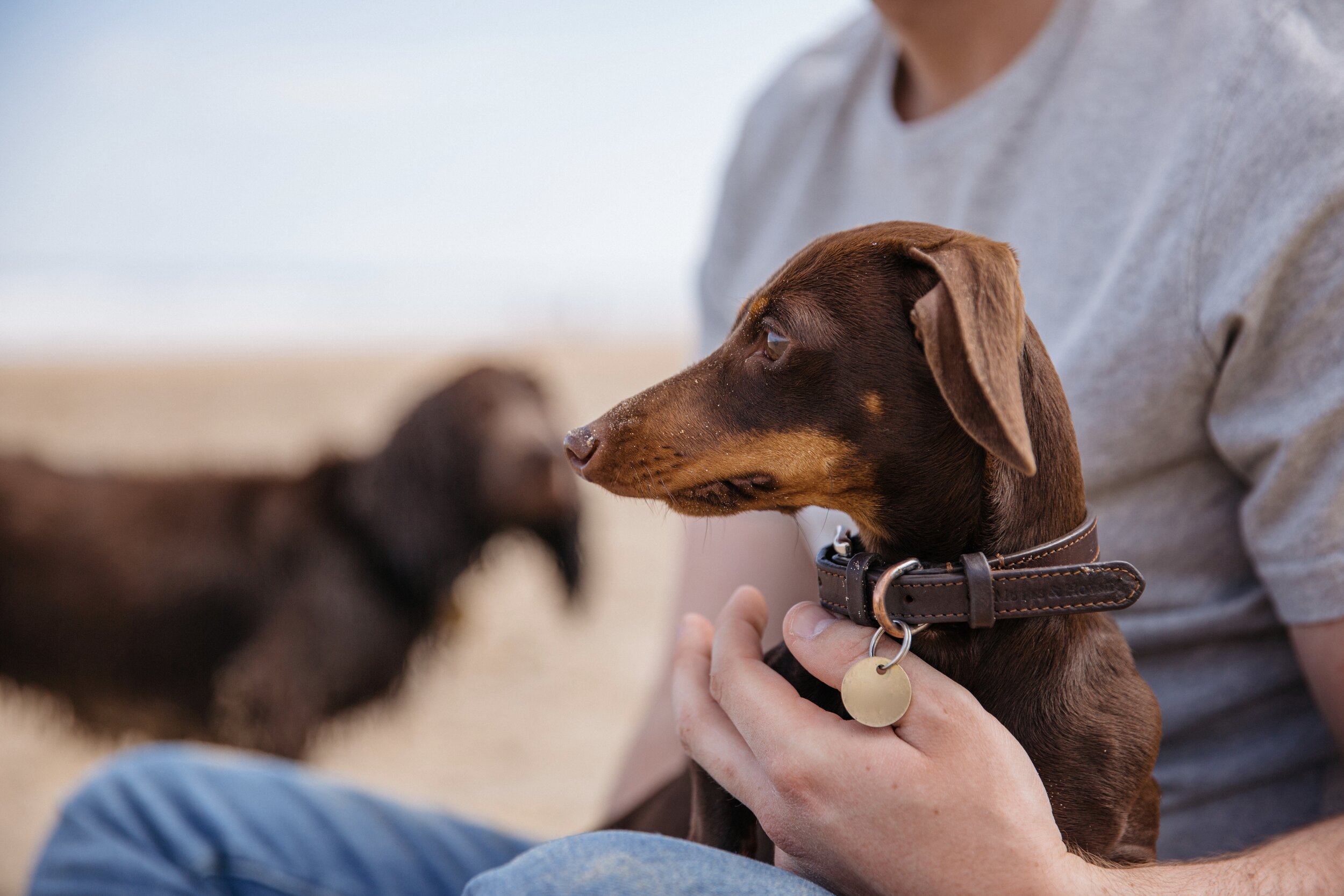
A Resolution for Separation Anxiety
A Unique National Programme designed to radically improve on just counting minutes. Proper diagnosis, quality training, and a clear resolution.
James is exceptional and has helped us enormously. Before he visited us less than 3 months ago we could not leave our rescue Greyhound Friday alone in the house because he would howl, race back and forth between the door and the window, and chew the blinds. With one home visit from James and a few follow-up calls, Friday is now fine to be left alone for hours at a time. He is happier in himself, and we are ecstatic about being able to go round to see our friends or go for dinner on our own without having to worry.
Before this, we had tried to find a solution for over a year. We had tried many different techniques for solving separation anxiety, including the Julie Naismith Be Right Back method, but none had worked. We felt Friday didn't have separation anxiety per se, but more like FOMO, yet we could not find anything that worked for more than five minutes.
James's visit changed all that. He has such a calm manner, and took the time to understand both Friday and us. He explained so clearly what the issue was, and it suddenly made a lot of sense. He then explained the path to solving it, and we saw immediately that this was likely to work. Once James had left, Friday's improvement was rapid. While we did have some small stumbles as we sought to understand how Friday responded, these were quickly sorted through the follow-up phone calls, where James was so generous with his time and advice. The peace of mind he has given us is priceless.
✶✶✶✶✶
Ben, Evelyn & Friday

Separation Anxiety Feels Permanent.
It isn’t.
Most people who reach out to us have already tried something. A Kong, a licky mat, the radio left on, a worn t-shirt by the bed. Calming sprays, plug-ins. “Doggy TV”. And when none of it worked, the conclusion they draw - reasonably enough - was that their dog was just one of the difficult ones.
They weren’t. The approach was.
Separation anxiety is one of the most resolvable conditions we work with. The vast majority of dogs we see go from unable to be left at all, to relaxed and settled for meaningful periods of time — usually within a matter of months. Not because we have a magic method, but because we start in the right place.
Most separation anxiety programmes are built around the same idea: leave your dog alone, start with seconds, build up to minutes, repeat.
The logic sounds reasonable. The problem is, it teaches the dog nothing.
A dog that’s been alone for 30 seconds without incident hasn’t learned to relax. It’s just been alone for 30 seconds. The anxiety is still there - unaddressed, unresolved - and the clock is still running.
Owners end up with a dog that seems fine for five minutes, ten minutes, apparently making progress — right up until the first time they leave for fifteen minutes. Then everything falls apart.
We start somewhere different. Before we ever ask your dog to be alone, we teach them to genuinely relax — independently, confidently, with you still in the room. Because a dog that can’t switch off when you’re there has no foundation whatsoever for switching off when you’re not.
Solve that first. The rest follows.
Separation Anxiety is a Distance issue, not a Time issue.
One of the Core Principles of solving Separation Anxiety is understanding how our dogs relate to our personal and intimate space, and how they manage their own.
Dogs that struggle with separation aren’t simply anxious about being alone. They’ve never learned to be comfortable in their own space — even when you’re in the room. They follow, they crowd, they can’t settle unless they’re close. The relationship with distance hasn’t been established, so the relationship with absence can’t be either.
It takes an average of 3 months to take our clients from not being able to leave their dogs at all, to happy dogs being left comfortable and relaxed for around 2 hours or more. Whilst every dog is different, and every dog progresses at their own pace - these three building blocks mean that the majority of our clients can reach a meaningful resolution that actually gives them their lives back in a reasonable timeframe.
The Three Piece system we use to take our clients from Struggling to Settled.
Independent Relaxation
Teaching your dog how to make the decision to relax on their own - anytime, anywhere, regardless of who’s present. Building confidence, independence and the ability to self regulate is an essential piece of overcoming Separation Anxiety.
Independent Sleep Routine
When you leave, all you want your dog to do is rest. An independent sleep routine gives your dog the opportunity to practice this every night, with you still in the house. In your dog’s mind, leaving to go to bed and leaving to go out the door should mean the same thing - sleep.
Setting boundaries
Helping your dog to understand when they can be close, when they can follow - and crucially when they can’t - is the final piece of the puzzle. Your personal space is precious, and it’s important to set the same boundaries with your dog that you do with people. It’s just polite.
Start changing your perspective.
Members Page Exclusive Preview.
There’s a Human Side to This Too.
Separation anxiety doesn’t exist in a vacuum. Dogs and owners are in it together — and in our experience, the most effective work happens when we acknowledge both sides of the relationship.
Dogs are extraordinarily good at picking up on the emotional state of the people they love. If you’re anxious about leaving, your dog knows. If you’ve been dreading the moment you walk out the door, they’ve felt that too. It’s not weakness — it’s just how the relationship works.
We’re used to working with the whole picture. Whatever you’re carrying into this process, we’re used to that too. And we treat it as part of the work.
The Separation Anxiety Programme
You're here because you can't leave the house. That's the problem we solve — completely.
Our complete programme for separation anxiety. One price, covering everything from your first assessment onwards — with a plan built around your dog, your routine, and where you live. Wherever you are in the UK.
-
Most dogs get there in around three months. Some take longer. The price never changes.
Many pet insurance policies cover behavioural work — check yours.
-
It starts with a full assessment of your dog, your home, and your routines — because separation anxiety lives in the detail of how you and your dog share space. From there, we build your plan: shaped to your dog, your circumstances, and your location, and guided week by week, on a call, for as long as the work takes. You'll see changes within weeks. We keep going until your dog can be left — relaxed, settled, for meaningful periods of time.
Where the plan calls for in-person work, it's included. The programme covers what your dog's case needs. That's what the price means.
-
The programme includes Lifetime Membership of The Dog's Way — phone and WhatsApp support whenever you need it, our full video and digital library, and 33% off any one-to-one session, for the life of your dog.
Your Questions Answered.
-
The short answer - as long as it takes for your dog to be comfortable and settled when left alone for 2 hours. In practice, the typical range is from 2 months to 6 months depending on a client’s individual circumstances - the average being 3 months from start to finish.
-
Yes! Before starting your programme, we make a custom plan based on your needs and location. Remote assessments for clients outside of North Yorkshire are offered across the UK through phone and video.
The majority of the programme is done remotely through weekly catch up calls, WhatsApp, and through our video training library and downloadable booklets - so as long as you have a smartphone, we can work with you.
-
If your dog is exclusively dealing with separation anxiety, and doesn’t have any other behavioural issues (which may or may not be related) then no, I don’t need to see them in person - providing you can send regular video updates via WhatsApp.
If I feel that a severe case needs in person support, this will be planned and agreed on the phone before you sign up to the programme. It doesn’t affect the cost or involve any hidden fees - decisions are made on a case by case basis - but it may mean a slightly longer wait (2-4 weeks) to start your programme if you need to be seen in person.
-
If you’re asking, you already know the answer. Independent sleep (which means not with you, or in your room) is one of the three key skills your dog needs to learn to be able to rest and relax when they are on their own in the home. Which means that at some point in the programme, you will be taught how to create healthy separation over night.
This is by far the number one thing my clients push back on, and also the most important part of success. If you struggle with this idea, think about the wider implications of what that says about your own issues with attachment and separation - and how your dog might perceive your own anxieties.
In simple terms, dogs who cannot sleep independently do not typically achieve successfully being left beyond 30 minutes - so for real, meaningful change, it’s not something you can compromise on. -
Sometimes referred to as Be Right Back, door is a bore, one minute at a time, incremental separation.
No, we don’t - because it doesn’t work. Not only do these programmes fail to teach anything new that the dogs can learn, but they typically involve creating false positives in which the owners believe they are making slow but steady progress as they slowly build their dogs up from 1 minute to 15 minutes. These are not meaningful timeframes for dogs or people.
Unfortunately, beyond 15 minutes (typically 6 months into the programme) is when the dogs begin to fail and revert, because there is no actual training in place for them to utilise, and many of these systems then blame the owners for not being patient, slow, or consistent enough in their training.
These training systems are not benign - the result is often that the owners themselves are left with elevated stress, anxiety, guilt and hopelessness through no fault of their own. We want all of our clients to understand that training should be a cooperative process, not one where shame or blame are used to add pressure or deflect responsibility on the part of the trainer. we believe that the vast majority of clients commit to a process of change and work their hardest to enact it, and that our job is to support them in that process.
-
Most anxiety medications are prescribed ‘to be used alongside a training programme or with the guidance of a behaviourist’. This programme is designed to address root causes of separation anxiety and other symptoms, and is generally effective without the need for medications.
There are scenarios where genetics, early spay/neuter, or other medical issues may be exacerbating anxiety in a way where medications may help ease these symptoms. However, these are often over prescribed, and not in any way a prerequisite to training.
We prefer that dogs do not start their training program on SSRIs or sedatives, so that we can get an accurate picture of stress and other related behaviour. Trazodone in particular is a strong sedative, and doesn’t allow us to accurately understand how your dog is feeling. If you are concerned about managing your dogs symptoms, please discuss with us on a call before making changes to medication.
-
No we don’t. The symptoms of separation anxiety are exactly that - symptoms of a dog that is unable to self regulate.
This programme is built on calm place work without food as a basis for relaxation, which is generalised in a range of contexts. Massage is used to nurture calm and relaxed state in your dog.We also teach appropriate boundary setting with clear and gentle body language communication, a lead to guide dogs to where we want them to be, vocal instruction and disagreement, and a focus on how our own behaviour patterns influence the way our dogs respond.
A big part of the programme is focused on your own therapeutic experience, talking through how you are feeling, what creates stress or anxiety or fear for you - and techniques that can help you to process those feelings in simple, practical ways that positively influence your dog. -
The truth is that dogs know how we feel, and when life’s biggest challenges knock us sideways, our dogs know that we need them to be close. Sometimes, what we experience as separation anxiety is actually a dog responding to our own emotional cues, and trying to solve an unsolvable problem in us by attaching themselves to us.
If you have recently lost a loved one - human, dog or otherwise - your first priority should be quality grief counselling and support. When you are ready, we will be here to help - but please take as much time as you need to ensure that when you want to start solving separation issues, you are in a place where you are able to ask for some distance. They won’t listen if you aren’t ready.
THE JOURNAL | featured Case Profiles

After an intense 3 month period of stress in our house our 2.5 year old spaniel had become very upset about being left alone in his crate or in the house at all.
James kindly fitted us in promptly after my call for help & within 10mins of watching our dog & listening to our story he knew how to tackle it. He left us with a clear plan. 3 weeks later we have our happy, relaxed spaniel back & more importantly, as a family, our lives beyond home as we can leave him again at home & know he’s safe & happy.
Honestly James was amazing & so generous with his time & expertise. He rescued us. Thank you!!!!
✶✶✶✶✶
Lindsey & Cosmo
James (and The Dogs Way) work miracles! I rehomed my 11 month old Working Cocker Spaniel 2 months ago and it soon became apparent she really struggled with separation anxiety to the point which I couldn’t leave the room for a matter of seconds without her crying and clawing at the door. At a loss for how to resolve this I gave James a call and after the initial phone consultation I had all the confidence in the world if anyone was going to help Cally it would be James. We had a home visit the following week and I was amazed at how quickly Cally took to what James was teaching us. Fast forward to not even 2 weeks since the home visit and I’ve just been able to leave Cally for an hour and a half with absolutely no whimpering, crying, scratching! It genuinely feels like we have a different dog! I couldn’t recommend James and The Dogs Way enough!
✶✶✶✶✶
Chloe & Cally
James has been amazing and massively helped us resolve separation anxiety in our 8 year old Jack Russell. We were like prisoners in our own home as we were terrified to leave the house, most of the time we would come home to destruction. We have tried everything in the past such as leaving the radio on, Kong toys, leaving clothes with our scent, nothing worked. James came to our home to establish the root cause of the behaviour, he explained in details what the issues were and how to fix them. We had weekly check in calls to see how we were progressing. As Ruby is 8 years old I assumed it would take considerably longer to see any improvement. Within just a few weeks we were seeing massive improvements and are now able to leave the house. I cannot thank James enough for the tips and advice he has given and would definitely recommend to others. You need to be fully committed and put the time and effort into training but the end result is very much worth it.
✶✶✶✶✶